 6dfabd578f
* Rename SiteConfig

* More renaming

* Update spec

* Update mandatory settings mapping

* More renaming

* e2e test fixes

* You have a rename, and you have a rename

* Spec fix

* More changes

* Temporarily disable specs

* After-merge update

* Undo rename for migration

* undo rename of DUS

* Fix DUS

* Fix merge problem

* Remove redundant DUS

* Fix specs

* Remove unused code

* Change wrong class name

* More cleanup

* Re-add missing values to constant

* Fix constant

* Fix spec

* Remove obsolete fields

* Add accidentally removed field

* Update spec

* Move methods from Settings::General to ForemInstance

* Remove unneeded model

* Change mentions of 'site config'
2.6 KiB
| title |
|---|
| Configuration |
Configuration
We currently use the following gems for configuring the application:
dotenv
This gem is used for configuring environment variables for test and development environments. Examples:
REDIS_URLFASTLY_API_KEYSTRIPE_SECRET_KEY
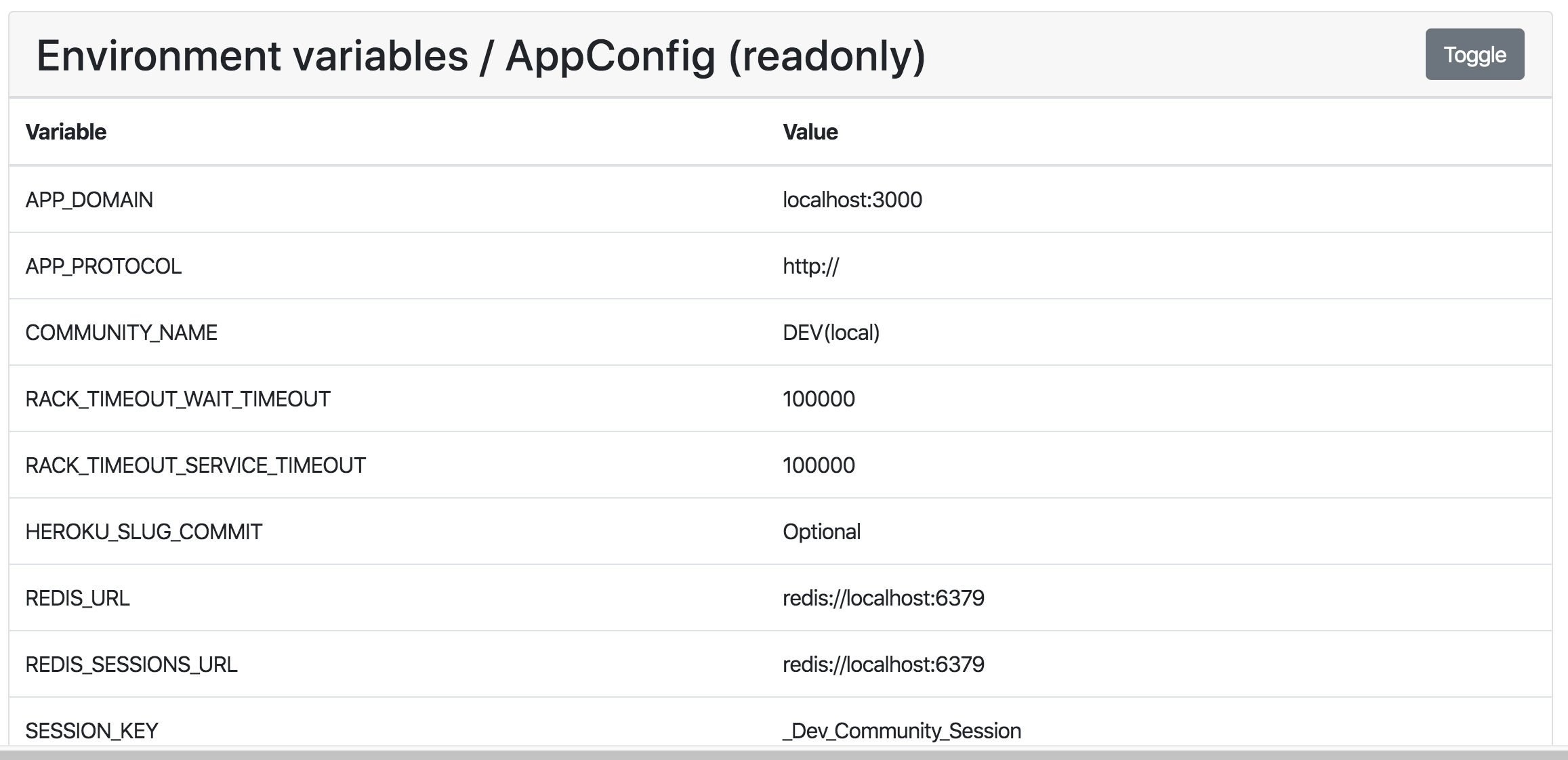
Settings managed via your ENV can be found in
Configuring Environment Variables) and viewed at
/admin/customization/config (see the Admin guide):
rails-settings-cached
We use this gem for managing settings used within the app's business logic. Examples:
Settings::General.main_social_imageSettings::RateLimit.follow_count_dailySettings::Authentication.twitter_secret
These settings can be accessed via the
Settings::General
object and various models in the Settings:: namespace and viewed / modified
via /admin/customization/config (see the Admin guide).

Vault
The vault Ruby gem allows us to interact with
Vault. In a nutshell, Vault is
a tool for securely storing and accessing secrets. It is completely optional for
running a Forem. To access it we use the wrapper AppSecrets.
class AppSecrets
  def self.[](key)
    result = Vault.kv(namespace).read(key)&.data&.fetch(:value) if ENV["VAULT_TOKEN"].present?
    result ||= ApplicationConfig[key]

    result
  rescue Vault::VaultError
    ApplicationConfig[key]
  end

  def self.[]=(key, value)
    Vault.kv(namespace).write(key, value: value)
  end

  def self.namespace
    ENV["VAULT_SECRET_NAMESPACE"]
  end
  private_class_method :namespace
end
We attempt to access a secret from Vault if it is enabled, i.e. if the
VAULT_TOKEN is present. If Vault is not enabled or if we cannot find the
secret in it, then we fallback to fetching the secret from the
ApplicationConfig.
One advantage of using Vault with Forem is that it allows you to update your secrets easily through the application rather than having to mess with ENV files. If you would like to try out Vault, follow our installation guide for setting it up locally.